
De pagina ververst bij het selecteren van een onderwerp.
Sla artikel navigatie over.Portfolio policy
Regional segmentation
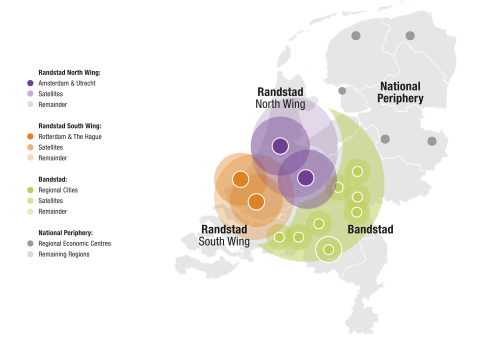
The ARC Fund invests in the Dutch residential sector with a strong focus on affordable/attainable, high-quality and sustainable residential properties located in regions and municipalities with the best economic and demographic potential. In 2022, we updated the regional segmentation approach to more accurately reflect the attractiveness of the municipalities we are active in. The purpose of this update is to improve our forecasts for the vacant possession value, capital growth and (market) rent growth. Our focus areas include the Central Circle – the largest cities in the north, south and east of the Netherlands and their satellite cities, as well as the Regional Economic Centres as defined below.
Randstad – North Wing
• Amsterdam and Utrecht
• Satellite cities, including Almere, Amersfoort, Haarlem and IJsselstein
• Remainder, including Blaricum, Uithoorn and Veenendaal
Randstad – South Wing• Rotterdam and The Hague
• Satellite cities, including Berkel en Rodenrijs, Delft, Leiden and Nootdorp
• Remainder, including Alphen aan den Rijn, Barendrecht and Gouda
Bandstad
• Regional cities: Eindhoven, Breda, Tilburg, 's-Hertogenbosch, Arnhem, Nijmegen, Apeldoorn and Ede
• Satellite cities, including Elst, Nuenen and Oosterhout
• Remainder, including Culemborg, Geldermalsen and Velp
National Periphery
• Regional Economic Centres: Groningen, Leeuwarden, Zwolle, Deventer and Enschede
• Remaining Regions
Figure 13: Regional segmentation
Rental market segmentation
The ARC Fund focusses on affordable/attainable rental homes in the mid-priced segment, consistent with the Amvest vision ‘fair living for all generations.’
The Affordable Rent Act (2024) divides the mid-priced rental market into a liberalised and a regulated segment based on WWS-points.
The ARC Fund adheres to the definitions of the Dutch government of middle-income households:
-
Middle-income: an annual income of €49,669 to €67,366 for one-person households and €54,847 to €89,821 for multi-person households.
We have determined the maximum rents for four rental segments: low-priced, lower mid-priced, upper mid-priced and higher-priced. We define affordable/attainable as a monthly rental price of no more than one fourth of the monthly household income. In addition, we take into account regional variations in rental prices.
Region | Mid-priced* | Lower mid-priced** | Upper mid-priced | Higher-priced |
Amsterdam & Utrecht | < €900 | €900 - €1,185 | €1,185- €1,650 | €1,650 > |
Randstad - North Wing - Satellites | < €900 | €900 - €1,185 | €1,185 - €1,500 | €1,500 > |
Randstad - North Wing - Remainder | < €900 | €900 - €1,185 | €1,185 - €1,400 | €1,400 > |
Rotterdam & The Hague | < €900 | €900 - €1,185 | €1,185 - €1,500 | €1,500 > |
Randstad - South Wing - Satellites | < €900 | €900 - €1,185 | €1,185 - €1,400 | €1,400 > |
Randstad - South Wing - Remainder | < €900 | €900 - €1,185 | €1,185 - €1,400 | €1,400 > |
Bandstad - Regional Cities | < €900 | €900 - €1,185 | €1,185 - €1,450 | €1,450 > |
Bandstad - Satellites | < €900 | €900 - €1,185 | €1,185 - €1,450 | €1,450 > |
Bandstad - Remainder | < €900 | €900 - €1,185 | €1,185 - €1,400 | €1,400 > |
Remaining Economic Centres | < €900 | €900 - €1,185 | €1,185 - €1,300 | €1,300 > |
Remaining regions | < €900 | €900 - €1,185 | n.a | €1,185 > |
* Indexed social segment from €900.07 monthly rent
** 186 WWS points equals €1,184.82
Target groups
Our target groups are based on market trends and developments and determine our product-market combinations. Our primary target groups are:
-
Young professionals: focus on mid-sized and large cities and the availability of amenities.
-
Elderly singles and couples: focus on life-cycle proof housing concepts near daily amenities to appeal to a growing 65- and-older population.
-
Families: focus on traditional and affordable single-family housing (SFH) and multi-family housing (MFH) solutions.
-
Key workers: focus on affordable SFH and MFH housing solutions.
-
Expats: focus on serviced apartments and SFH and MFH units near mobility hubs.
Area management
Area management is an important part of the ARC Fund strategy. Amvest’s role as a project and area developer and our Right of First Refusal agreement create attractive opportunities for investment. By investing in high-quality environments with the right amenities for the right target groups, we increase the value of our assets, the quality of our properties and grow demand. Our continued focus on area management is consistent with the following trends and projections:
• Growing significance of location (identity, proximity to amenities)
• Lack of attractive housing concepts for the 65-and-older population currently occupying SFH.
Community management
To help solve the shortage of affordable housing, particularly in the largest cities, we invest in MFH solutions characterised by compact individual or shared apartments in a high-quality environment. We apply community management to contribute to the quality of the living environment. The ARC Fund’s community management concept is known as Livvin. Its pillars are:
-
The Community Space to provide a place to connect and socialise.
-
The Community Manager to assist tenants, forge connections and build the community.
-
The Community App as a one-stop shop for tenants to participate in their community and manage service requests.
Community management is also key to our co-living concept 2Peer. This concept is targeted towards singles and young professionals in the four largest cities in the Netherlands. It features shared apartments (c. 40m2) with private bedrooms and bathrooms and shared living rooms and kitchens. These properties are in proximity of public transportation and may include amenities such as flexible workspaces and gardens. It is consistent with the following trends and projections:
• The growing number of single-person households
• A growing sense of loneliness among older populations and millennials
• The rise of the sharing economy (e.g. shared vehicles, workspaces)
• Working from home trends
Sustainability
As part of our strategy, we invest in sustainable real estate and in sustainability improvements of our standing assets. We align our environmental, social and governance (ESG) strategy with the Amvest Impact Framework, a set of sustainability standards that, along with financial return requirements, will guide future investment decisions. The framework describes the four themes and 12 goals by which Amvest will assess and measure the sustainable impact of investments. These themes are environmental impact, climate adaptation, quality of life and occupier satisfaction. Additionally, we periodically assess our stakeholder interests by conducting a materiality assessment.
ESG initiatives by theme
Environmental impact – Roadmap to Paris proof
We are committed to achieving a Paris-proof portfolio to help achieve the Paris Agreement climate goals and limit the global temperature rise to 1.5°C. Through 2030, we will take action to reduce our carbon emissions and energy intensity (kWh/m2) in line with the CRREM (Carbon Risk Real Estate Monitor) reduction pathways.
The CRREM framework analyses the current environmental performance of our portfolio to provide long-term CO2 and energy intensity reduction pathways that are consistent with the Paris climate goals. The analysis is based on a combination of estimated energy consumption and CO2 emissions per asset based on publicly available data (build year, energy label and floor area) and actual data.
We involve external experts to map and budget sustainability improvements at the asset level, taking into account the asset type (MFH or SFH), the current environmental performance of the asset and the technical feasibility. We will plan sustainability improvements to coincide with regular long-term maintenance activities to optimise cost efficiency. In addition, we will time investment decisions to avoid any stranded assets, which CRREM defines as properties that will not meet future energy efficiency standards and are at risk of becoming economically obsolete as a result.
The CRREM framework may also inform future divestment decisions. However, we will make a reasonable effort to improve the sustainability performance of properties prior to their sale.
Climate adaptation
We are developing a climate adaptation strategy to mitigate the risks of climate change on our tenants, including drought, heat stress, excess water and flooding.
We are partnering with Climate Adaptation Services (CAS) and using the Fifth Assessment Report (AR5) by the Intergovernmental Panel on Climate Change (IPCC) to conduct a risk assessment of our portfolio. This approach is supported by the Dutch Green Building Council (DGBC), of which Amvest is a partner. The starting point of our risk assessment is the climate effects atlas (‘klimaateffectatlas’), which provides insight into climate risks at a regional and local level. We refer to these risks as ‘gross climate risks.’ To assess ‘net climate risks’ at the building level, additional research is required. We will continue to expand on our risk assessment, beginning with assets located in high-risk areas, to determine the net climate risks. The outcomes of this assessment will inform our mitigation strategy.
The risk assessment also supports our efforts to report in accordance with the EU Taxonomy. Assets that pose no high or very high risk according to the CAS climate scan meet the EU Taxonomy standards of ‘do no significant harm’ and can be considered taxonomy aligned.
-
Drought: many areas are experiencing more frequent and more intense droughts, resulting in falling groundwater levels and wildfires. Potential financial consequences include the cost of repairing or replacing damaged homes (e.g., foundation damage due to subsidence or the ‘sinking’ of land) and lower rental income.
-
Heat stress: extremely hot temperatures resulting in heat stress, leading to discomfort and (severe) health problems. Potential financial consequences include investments in cooling and other mitigation strategies, and reduced demand for properties sensitive to heat stress.
-
Excess water: heavier and more frequent rainfall resulting in excess water problems during short, high-intensity showers and a rising groundwater level. Potential financial consequences include the cost of repairing or replacing damaged homes (e.g., flooring, mold) and a loss of rental income due to the uninhabitability of the property.
-
Flooding: rising sea levels and water levels may cause flooding upon failure of levees and gates. Potential financial consequences include the depreciation of real estate (e.g., damage and assets in high-risk areas) and a loss of rental income due to the uninhabitability of the property.
Quality of life – Suitable homes for seniors
Many seniors live in homes that no longer suit them, for example because they lack a stair lift or elevator, or because they are too large for their household composition. However, due to a lack of suitable alternatives, the willingness to move is low. As the population ages, the shortage of suitable homes for seniors will continue to grow. Our strategy addresses the housing needs of older residents. We invest in housing concepts that offer an attractive alternative to conventional SFH units. This investment strategy also contributes to the Dutch government's goal to increase the supply of suitable homes for older residents and, as a result, improve mobility in the housing market. The objective of the government's ‘Housing and care’ programme is to (re)build 170,000 zero-step homes, 80,000 clustered homes and 50,000 homes for seniors requiring more care by 2030.
Zero-step homes are designed to provide step-free access to and within the home. They are typically located near essential amenities. In the Netherlands, there are an estimated 2 million zero-step homes, of which only 42.4% are occupied by senior residents.
We are currently assessing which homes in our portfolio meet the official definition of a zero-step home. This assessment will enable us to market those homes accordingly and position them as suitable for senior residents. In addition, the findings may inform future targets to increase the share of zero-step homes within our portfolio.
Occupier satisfaction – Customer journey
We strive to be transparent and approachable for our residents to enhance their living experience. To this end, we launched our Customer Journey initiative focussed on improving our residents’ experience from the moment they begin their housing search and throughout their tenancy. In 2023, we mapped several customer journeys related to renting, repair requests and renovation requests in detail and assessed opportunities to improve existing systems and processes. These journeys reveal ‘moments of truth’ that have a significant impact on the tenant experience. We will use the insights of the customer journey mapping exercise to develop concrete improvement initiatives related to key moments of truth. Priorities include:
-
Standardised marketing and orientation procedures: Opportunities include developing marketing packages based on project size and establishing sustainable partnerships with online marketplaces for real estate (e.g., Funda).
-
Managing expectations with regards to renovations
-
Flexible lease end dates
-
Repair request: Opportunities include the roll-out of a new Customer Relationship Management (CRM) system, enabling property managers to view tenants’ support requests, assign requests to a partner or contractor and access the status of the request.
Digital services
We continue to offer digital services to our tenants through the Community App. The purpose of the application is to support community building and tenant satisfaction. Tenants can submit their service requests through the application, which connects with the CRM. They may also use the application to connect with members in the community and to arrange (housekeeping) services.