De pagina ververst bij het selecteren van een onderwerp.
Sla artikel navigatie over.Risk management
Amvest organisation corporate risk strategy
The strategy of the Amvest organisation focusses on two key activities:
-
Dutch residential area and property development in economically attractive regions.
-
The set-up and management of Dutch investment funds and portfolios covering the residential sector.
The Amvest organisation is thus active across a large part of the real estate value chain. The link between these two key activities forms the basis of the Amvest business model: Amvest is able to create and benefit from the synergy between these activities. Therefore, part of the corporate risk strategy focusses on adequately managing and mitigating the inherent ‘conflict of interest risk.’
The structure and governance of the AL&C Fund, as well as the oversight role from the depositary, and the Dutch Financial Markets Authority (AFM), help mitigate this risk.
Internal control environment
The Amvest Risk Management Framework is designed to facilitate strong governance and risk management within the AL&C Fund. The framework is based on a control framework, which separates the function of financial and portfolio management from the function of risk management to guard against conflicts of interest.
Control framework
Fund management is responsible for all fund-related activities, including managing the control environment and risks.
The Risk & Compliance Officer (RCO) coordinates, facilitates, reviews and advises on risk management procedures in consultation with the Director Finance and Risk to safeguard the adequate management, control and reporting of risks by the Fund Manager. The RCO acts independently from line management, and remuneration is not tied to the Fund's performance.
The Advisory Board serves as an escalation line for the RCO, independently of line and risk management. The members of the Advisory Board are representatives of the investors.
Assurance on risk relating to failure of systems and processes
The Fund Manager is structured with an affiliated Fund Services Provider (Amvest Management B.V.). The Fund Services Provider employs all employees of Amvest Group and provides certain services to the Fund Manager. An ISAE 3402 Type II framework is in place to support a consistent, high-quality level of services by the Fund Services Provider to the Fund Manager. Relevant processes carried out by the Fund Services Provider under the responsibility of the Fund Manager are described at an operational level. Control objectives and controls as part of these processes are defined.
Each year, Amvest’s external auditor audits and reports on the design and effectiveness of controls, as well as General IT Controls (GITC) based on the ISAE 3402 Type II standard. Amvest selects key controls within the most important business processes to be audited, primarily related to acquisitions, property and individual unit sales and operations. Fund Management periodically assesses these controls in close consultation with the fund team, the RCO, the Fund Services Provider and the external auditor of the AL&C Fund.
For 2025, (1 January 2025 - 30 November 2025), the external auditor issued an unqualified ISAE 3402 Type II report.
AL&C Fund Risk Management Framework
The Fund Manager applies a Risk Management Framework to identify, measure, manage, monitor and report risks, and sets the corresponding risk indicators, limits and risk appetite.
Fraud risks are integrated into this framework, as fraud is considered an inherent operational risk that may lead to financial loss or reputational damage. Industry standards highlight that fraud may arise where opportunity, pressure and rationalization converge, underscoring the need for robust preventative and detective measures. To mitigate these risks, internal and external fraud risks are addressed through a system of internal controls embedded in daily processes, including segregation of duties, authorization procedures, access controls and automated checks.
The Fund’s risk management structure is staffed by the Director Finance & Risk and the Risk and Compliance Officer. In addition, Amvest is subject to an independent ISAE‑based assurance framework. Under ISAE 3402 key processes and controls are annually tested by an external auditor to assess design and operational effectiveness.
During the reporting period, no instances of fraud with a material impact on the Fund were identified.
Every quarter, or more frequently in case of significant events, the defined risk categories are assessed in close consultation with the Portfolio Manager. Findings are reported in the quarterly Investor Report’s Risk Management Dashboard. The Director Finance & Risk is responsible for reporting to all relevant stakeholders.
Identified risks of the AL&C Fund
-
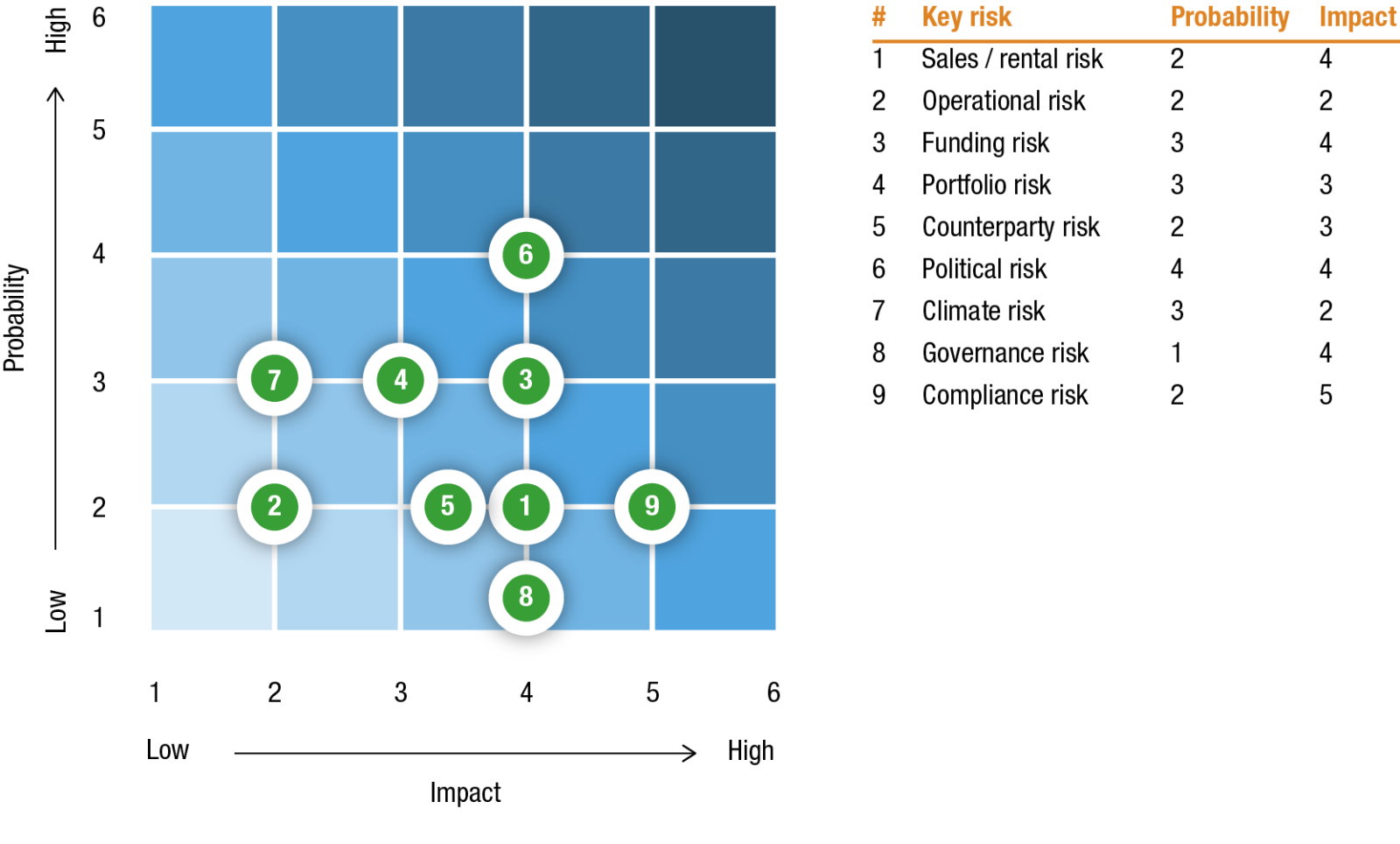
Rental risk: the risk that a property cannot be rented out (again) within the envisaged period at the targeted rental price. This risk is particularly relevant for the AL&C Fund due to the limited number of care service providers as single tenants (i.e., potential tenants) and the potentially difficult process of finding a (new) care provider for a care home. Following the completion of the first assisted living projects, this risk also includes the letting out of apartments to individual owners.
-
Operational risk: the risk resulting from inadequate or failed operational processes and/or systems.
-
Portfolio risk: the risk that the portfolio development and operational results are not in line with the Portfolio Plan and, as a result, targeted returns are not achieved.
-
Funding risk: the risk of funding shortages and mismatches between funding and commitments because the AL&C Fund:
-
-
is unable to timely fund its commitments with new or existing equity;
-
incurs short-term liquidity shortages due to the insufficient coordination (by timing and amount) of cash inflows and outflows.
-
-
Counterparty risk: the risk that a counterparty fails to fulfil contractual obligations or other agreed upon obligations and / or harms the reputation of the AL&C Fund. The main counterparties for the AL&C Fund are tenants (e.g., care service providers), investors, property developers and appraisers. In addition, the AL&C Fund is at risk of being too dependent on one or more counterparties such as care service providers (concentration risk) or development contractors.
-
Political risk: the risk that policy changes and regulations by (local) authorities or governmental bodies affect the strategic objectives and business of the AL&C Fund.
-
Climate risk: the risk that the AL&C Fund is not adequately adapting to constraints resulting from climate change, climate policy, climate adaptation strategy and/or fails to adequately report on its actions to address climate change.
-
Governance risk: the risk that a conflict of interest is not adequately addressed by means of governance as well as checks and balances, and/or the risk that the AL&C Fund is inadequately equipped to operate in the event of a conflict of interest.
-
Compliance risk: the risk that the AL&C Fund and its operation are in breach of legislation and regulations and / or is non-compliant with the Fund’s AIF status.
Risk appetite and evaluation 2025
The AL&C Fund invests in income-producing real estate investments in the Dutch residential care sector. The generated returns from rental income are relatively stable, and the AL&C Fund acquires new projects on a turnkey basis, without incurring development risk. In line with its INREV core fund risk profile, the AL&C Fund has a relatively low-risk profile and correspondingly low-risk appetite.
During 2025, the risk indicators and risk limits for the risk categories, as defined by the Fund Manager, were closely monitored, and the risk framework was updated. Four quarterly risk meetings were held to discuss development of risk indicators together with the Director Finance & Risk, the Portfolio Manager and the RCO.
Portfolio risk
The portfolio risk improved compared to 2024. The Fund’s return performance benefited from considerable valuation gains in combination with an income return that was in line with the portfolio plan. The realised growth of the portfolio also contributes to further portfolio diversification.
Funding risk
The Funding risk improved, following the successful capital raise of €250 million as of 1 April 2025. The additional funds were used to repay a shareholder loan and fund project pipeline commitments. At the end of 2025, the available funding commitments exceeded the Fund’s hard pipeline commitments.
Political risk
Changes in (local) legislation, designed to interfere in the residential investment market or which limit the feasibility of new projects, may impact the AL&C Fund’s ability to execute its strategy. The AL&C Fund continued to experience negative consequences from utility grid congestion, which led to delays in the completion and the start of new projects. Although the contractual risk lies with the developer, the potential negative impact for the AL&C Fund increases the political risk.
Rental risk
The financial performance and strength of our care operator partners were internally reviewed in 2025. The strong performance of our partners leads to a stable rental risk. With the leasing of assisted living projects, we experienced that the letting process to the respective target group generally requires more time and effort compared to the leasing of traditional apartments.
Counterparty risk
During 2025, counterparty and concentration risk improved as the sizeable Trappenberg project is nearing completion. However, completion of one project is still pending as a result of utility grid constraints. This specifically increases the counterparty risk in relation to the developer and seller of the project, as the situation is not yet resolved. We continued to manage this risk effectively with no material defaults occurring.
Overall risk performance
None of the risk limits set by the Fund Manager for the defined risk categories were exceeded.
No material changes to the liquidity management systems and procedures occurred, and stress testing on liquidity showed no breaches in relation to the distribution policy as described in the Terms and Conditions and the Portfolio Plan. Various scenarios on funding, cash and liquidity were calculated and monitored. The newly raised equity commitments and the remaining uncalled equity (€260 million) create a solid funding position for the AL&C Fund going forward.
Updated Risk Management Dashboard
The AL&C Fund’s Risk Management Framework is a dynamic framework. The Fund Manager assesses, monitors and reviews the risk management function, policy, framework and its risk appetite, indicators and limits on an annual basis and reports on these matters to the Advisory Board and the investors of the AL&C Fund. If necessary, the Fund Manager adjusts previously described risk categories in close consultation with the RCO and its stakeholders.
Figure 8: Plotted risk (impact/probability)